Tempo Electric Logo       HOME       NEWS       ABOUT US       PRODUCTS       eMAIL LIST       CONTACT US       PURCHASE
Tempo Electric Pure Silver Audio Cables

Interconnects

 
Since 1992, we've been fabricating our own interconnects and loudspeaker cables. Based on a concept pioneered by the late Harvey Rosenberg, these have evolved over time into an elegant solution, free from hype and pseudo-science. The basic ingredient is extra soft temper, .999 pure, fine silver wire, jacketed in PTFE (Teflon) spaghetti tubing. While complete DIY instructions are still available on our sister site, The Vinyl Tourist, we now offer these on a custom-made basis for listeners have neither the time nor the resources for home brew. In fact, our custom fabricated cables and cords will basically cost you the same amount as you would otherwise spend on DIY. How can we do this? As an OEM, we're able to buy wire and connectors in bulk at wholesale prices. We sell them for the equivalent of MSRP and the spread between the two covers our overhead and manufacturing costs. Because we only sell direct, you're basically buying them at wholesale prices, too.


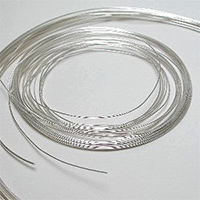
Coils of Pure Silver Wire

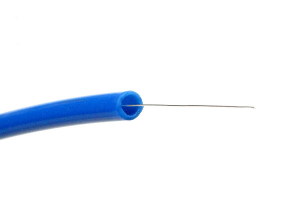
We purchase pure silver wire directly from a leading precious metals refinery that's been in business in the US for almost 100 years. As shown in the photo above, it comes bare, without insulation, in a coil or on a reel. We purchase the PTFE (Teflon) insulating jacket from another supplier and install the wire into the Teflon tubing ourselves. From an engineering point of view, PTFE is the best electrical insulator available. Even though Teflon has an extremely low coefficient of friction (which means that it's tough for anything to stick to it), it's still much easier to thread the wire into a slightly larger gauge of tubing. This is especially true if you are a DIYer with little experience and limited work space. By contrast, we've been doing this for almost 20 years and have a clear run of over 100 feet (30 meters) in our workshop, which makes it a lot easier to install long lengths of wire into the jacketing.
 
With practice, you can use the same gauge tubing as the wire, itself, but there's still a limit as to how much wire can be threaded into the same diameter tubing—usually 3 to 8 feet, depending upon the gauge. Based on our experience, 16 gauge to 10 gauge wire is fairly easy to thread into same size tubing, with a practical limit of about 8 feet (2.4 meters). Smaller gauges are difficult to thread into same size tubing beyond 3 feet (1 meter).
 
The tables which follow show our general recommendations for cable gauges and lengths, including jacket size, for DIY or assembled to order. As you look through the tables, you'll see that we usually suggest threading the silver wire into the next largest size Teflon tubing. It makes the task much easier and has no harmful effect on the sound.
 
 
Interconnects: Phono (Turntable or Tonearm) to Preamplifier
 
If your total length is:
Up to 8 Feet (2.4 Meters) Over 8 Feet (2.4 Meters)
We recommend this gauge (or diameter) wire
in this gauge (or diameter) Teflon jacket:
30 Gauge (0.25mm) Wire in
28 Gauge (0.32mm) Teflon Tubing
30 Gauge (0.25mm) Wire in
24 Gauge (0.5mm) Teflon Tubing
30 Gauge is also recommended for rewiring your tonearm.

 
Interconnects: All Other Signal Sources to Preamplifier, Preamplifier to Power Amplifier
 
If your total length is:
Up to 8 Feet (2.4 Meters) Over 8 Feet (2.4 Meters)
We recommend this gauge (or diameter) wire
in this gauge (or diameter) Teflon jacket:
24 Gauge (0.5mm) Wire in
20 Gauge (0.8mm) Teflon Tubing
20 Gauge (0.8mm) Wire in
16 Gauge (1.3mm) Teflon Tubing

 
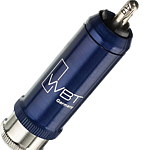
About the WBT-0110Ag NextGen RCA plugs
 
To terminate the interconnects, we especially like the WBT-0110Ag NextGen RCA plugs (shown in the photo at the top of this page) which utilize conductors made of pure silver, directly plated with platinum to limit oxidation. The body is constructed of Ultramid, while the negative contact uses Dyneon. In addition, the barrel is fabricated from an Aluminum/Magnesium alloy for improved rejection of EMI. Transmission bandwidth extends to 1 GHz and its 75 Ohm impedance makes this an outstanding connector for both digital (S/PDIF) and analog signals.
 
What makes the WBT NextGen line particularly attractive is its locking feature. Turn the barrel clockwise to unlock it, insert the plug into the socket, then turn the barrel counter-clockwise for an extremely secure fit. The locking feature makes an especially tight contact without forcing the barrel onto the socket, which is essential for optimum signal transfer. The grip is so tight, that you can actually suspend your preamplifier from interconnects that are terminated with these plugs. This is how we first saw the NextGen's displayed at the Winter Consumer Electronics Show in Las Vegas and what sold us on the design. The suggested retail price for a set of four NextGen Ag RCA plugs is currently $360. However, since we are an OEM, rather than a parts retailer, we can incorporate them into our designs for a much better price, but regret that we cannot sell these to you separately.
 
In late January or February, 2010, we plan to stock the more economical silver and silver-plated terminals from Eichmann and Cardas, respectively, neither of which feature a locking design. For a direct comparison of the Eichmann Bullet RCA with the WBT NextGen, we refer you to this review in TNT Audio.
 
 
Interconnects In Action
 
Interconnects In Action

 
Speaker Cables: Power Amplifier to Loudspeakers
 
Amplifier Output
(Per Channel):
If your total length is
up to 8 Feet (1 - 2.4 Meters),
we recommend the following:
If your total length is
over 8 Feet (2.4 Meters),
we recommend the following:
1 - 19 Watts 16 Gauge (1.3mm diameter) Wire in
16 Gauge (1.3mm diameter) Teflon Tubing
16 Gauge (1.3mm diameter) Wire in
14 Gauge (1.6mm diameter) Teflon Tubing
20 - 100 Watts 16 Gauge (1.3mm diameter) Wire in
16 Gauge (1.3mm diameter) Teflon Tubing
12 Gauge (2.1mm diameter) Wire in
10 Gauge (2.6mm diameter) Teflon Tubing
101 - 200 Watts 12 Gauge (2.1mm diameter) Wire in
12 Gauge (2.1mm diameter) Teflon Tubing
10 Gauge (2.6mm diameter) Wire in
8 Gauge (3.3mm diameter) Teflon Tubing
Over 200 Watts 10 Gauge (2.6mm diameter) Wire in
10 Gauge (2.6mm diameter) Teflon Tubing
10 Gauge (2.6mm diameter) Wire in
8 Gauge (3.3mm diameter) Teflon Tubing

 
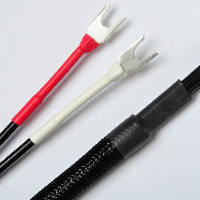
Speaker Cable SpadesThe same concept that we use for our interconnects applies to loudspeaker cables, as well. However, for the latter we usually don't terminate the wires at all, preferring instead to thread the bare ends into the binding post's center hole and gently tightening. However, if you prefer, we can attach any one of a number of spades or banana plugs. This is especially useful at the amplifier end if you're bi-wiring your loudspeakers.
 
The spades we like best include (left to right) the Alpha-Core Pure Silver Spade, the Kimber Postmaster, and the WBT-0680Ag Silver Signature Spade. While we use WBT lead-free silver solder with the first two, the WBT-0680Ag spade utilizes a compression fitting that's tightened with a dedicated Torx driver (shown far right).
 
Not illustrated, but available on special order, are the WBT-0610Ag Signature Banana Plugs. In early 2010, we plan to stock the Furutech and Eichmann Silver Bayonet Banana Plugs, as well as another more economical brand to be determined.
 
Speaker Cables with Protective Cover

 
If you're undecided about which termination (if any) is sonically superior, this paper [with emphasis on the conclusions added], written by former GE research engineer Bill Kenney and published in 1995 by the Boston Audio Society, finds that using no connector is best, followed by connectors whose metal content is identical to that of the wire, itself. In addition, his research (for a US Navy project) showed that given a choice, compression fittings are preferable to ones that are soldered on and, due to their relative lack of contact pressure, banana plugs are the worst termination of all. His observations about the sonic anomalies caused by the interface of dissimilar metals is why we use and recommend WBT silver binding posts and RCA sockets, as well as internal silver wire in the signal paths of all audio components, themselves. It's axiomatic that the more similar the conducting metal content is throughout the signal path, the better the end results will be.
 
 
Speaker Cables In Action

Speaker Cables In Action
(The amplifier's interconnect and power cord have been removed for the sake of clarity.)

A Note About the Purity of Silver
 
Everything we sell or fabricate is made from extra soft temper, .999 ("3-nines" or 3N) pure silver wire which we purchase directly from a refinery located here in the USA — one that's been a leader in specialty metals processing since 1912.
 
In our extensive listening tests, we've found that the temper (degree of hardness) is actually more important to good sound than the ultimate degree of purity. Once we tried it, it became immediately clear that the extra soft grade of silver exhibited dramatically less glare and more detail in the upper frequencies then the more commonly available regular or medium temper wire. This is the critical area of the sound spectrum which allows us, as listeners, to perceive the minute aural cues which characterize and differentiate various performance spaces.
 
Consider this — In the typical audio circuit, it's not unusual to find metals like gold, nickel, copper, aluminum, tin, zinc, chromium, rhodium, even lead, somewhere in the signal path. For example, virtually all circuit board traces are made from copper that has some form of plating applied to reduce oxidation. In addition, most high end capacitors are fabricated with tin, copper, or aluminum foil. Resistors, as well as capacitors, often have gold-plated, copper leads. The major element in solder, even silver or lead free, is tin and most jacks, connectors, and binding posts are made from gold-plated or rhodium-plated brass, an alloy of copper and zinc. Looking at the big picture, by the time the signal gets to the audio cable, whether or not the wire is made from .999, .9999, or higher-claimed* purity silver is irrelevant. What actually comprises that fraction of a percent of impurity in "pure" silver? It's mainly copper and other trace metals which are already in the circuit, just like the ones mentioned above. Why pay up to 500% more for extra "nines" when you'll never hear them?
 
* While refining silver to 99.99% (.9999 or 4-nines) purity is practical, though expensive, claims of 5-nines (99.999%), 6-nines (99.9999%), or even higher purity are simply false. Unless your're NASA and have unlimited funds, silver that has a degree of purity greater than 99.99% just does not exist in the marketplace.
 
Shields, Drains, and Grounds
 
At the moment, all of our interconnects and speaker cables are unshielded. From an electrical point of view, the only truly effective shield is 100% coverage with copper braid. Ideally, the copper braid should be terminated with a separate drain wire that can be connected directly to the earth conductor in the audio system's or home's wiring scheme (that's the green wire or third prong on an AC wall plug). This is the way balanced or XLR cables are shielded. The shield or drain should not be connected to the neutral wire in the audio cable. Otherwise, it can act as an antenna and make the problem worse!
 
The need for shielding is most common in the interconnect that connects the turntable to the phono preamplifier. Unfortunately, we've found that this type of direct shielding also tends to restrict the higher frequencies (>10KHz) which, in turn, reduces air and transparency. However, we are experimenting to find a way to configure a shield that avoids this problem. Based on personal experience, most audio systems don't require shielded cables, but there are situations where a power supply or a nearby radio station's broadcast tower can generate enough interference (EMI or RFI) to make it a necessity.
 
What about the third wire in a braid? Also called a drain wire, it's usually interwoven with the two principal conductors and soldered to the negative wire at one end. In commercial cables, that's the end towards which the arrow points. While it looks neat, we've never found this third wire to serve any useful purpose. As a shield, it covers such a small surface area, that it has no significant value and just seems superfluous.
 
Jacketing: Teflon vs. PVC vs. Natural Fibers (Cotton or Silk)
 
The type of jacket or insulating material used on audio cables is an area of recent interest in the high-end community. While PVC is a relatively inexpensive plastic, it only has moderate dielectric (insulating) properties. From an electrical point of view, Teflon or it's generic types such as FEP or PTFE, are far superior. It's also become trendy to install audio wire into cotton tubing or even silk.
 
Merits aside, never use cotton or silk insulation over wires that are used for high voltage applications. This includes the active circuits of amplifiers, preamps, or other components. You can use it as signal wire, but never in any part of the circuit where high voltage is present. A voltage spike can easily jump across the hot and neutral lines, burning through the insulation to cause a short circuit, damaging your component or even igniting a fire.
 
To date, we have not tried natural fiber insulators in our cables, so really cannot comment as to their value when compared to Teflon. However, this review in the 6moons eZine of several very expensive cable sets, jacketed with both natural and synthetic materials, ends with the conclusion that the ones insulated with a form of Teflon were the best sounding of all.
 
What is a Stereo Pair?
 
As you scroll down, you'll see unterminated wire listed by the foot and by the meter, priced as "stereo pairs." A stereo pair is (4) pieces of wire—two pieces to make up the left cable or interconnect and two pieces to make up the right. For example, if you plan to assemble a two meter long pair of interconnects, you would purchase a two meter stereo pair. The total wire length is actually 8 meters, but it will be cut into four 2 meter pieces for your convenience.
 
We also sell wire by the straight foot and straight meter. The price is the same regardless of how it's measured, but this allows you to buy coils for DIY projects where you're unsure of the finished length. Examples include rewiring loudspeakers, amplifiers or other components.
 
 
Prices: Pure Silver Interconnects, Extra Soft Temper, in a PTFE (Teflon) Jacket,
              Terminated and Ready to Use
30 Gauge (0.25mm diameter) or
24 Gauge (0.5mm diameter) is recommended for lengths up to 8 feet (2.4 meters).
 
20 Gauge (0.8mm diameter) is recommended for longer lengths.
30 Gauge (0.25mm diameter) Pure Silver Wire, Extra Soft Temper, terminated with
WBT-0110Ag Pure Silver NextGen Locking RCA Plugs
$243.50 per pair, up to 3.28 feet (1 meter) long
+$6 for each additional foot, per pair
24 Gauge (0.5mm diameter) Pure Silver Wire, Extra Soft Temper, terminated with
WBT-0110Ag Pure Silver NextGen Locking RCA Plugs
$250.00 per pair, up to 3.28 feet (1 meter) long
+$8 for each additional foot, per pair
20 Gauge (0.8mm diameter) Pure Silver Wire, Extra Soft Temper, in a PTFE (Teflon) Jacket, terminated with
WBT-0110 Ag Pure Silver NextGen Locking RCA Plugs
$263.25 per pair, up to 3.28 feet (1 meter) long
+$12 for each additional foot, per pair
Balanced (XLR) connectors from Furutech or Deltron are available by special order. Prices on request.
Coming in 2010:
  • Eichmann Bullet Plugs
  • Cardas Silver-Plated RCA plugs

 
Prices: Pure Silver Interconnects, Extra Soft Temper, in a PTFE (Teflon) Jacket,
              Unterminated for DIY Interconnects
For the DIYer, who wants to install their own RCA or XLR plugs
 
Note that XLR plugs require 3 wires per side, plus a braided copper shield (not included), for each complete stereo pair.
 
30 Gauge (0.25mm diameter) or
24 Gauge (0.5mm diameter) is recommended for lengths up to 8 feet (2.4 meters).
 
20 Gauge (0.8mm diameter) is recommended for longer lengths.
30 Gauge (0.25mm diameter)
$6 per foot, per stereo pair
$19.75 per meter, per stereo pair
A stereo pair = 4 lengths of wire, enough to make a complete set of Left + Right stereo interconnects
24 Gauge (0.5mm diameter)
$8 per foot, per stereo pair
$26.25 per meter, per stereo pair
A stereo pair = 4 lengths of wire, enough to make a complete set of Left + Right stereo interconnects
20 Gauge (0.8mm diameter)
$12 per foot, per stereo pair
$39.50 per meter, per stereo pair
A stereo pair = 4 lengths of wire, enough to make a complete set of Left + Right stereo interconnects

Speaker Cables with Protective Cover
 
Custom loudspeaker cables shown with optional WBT-0660Ag silver spades and protective covering

 
Prices: Pure Silver Loudspeaker Cables, Extra Soft Temper, in a PTFE (Teflon) Jacket,
              With or Without Termination
Prices for larger wire gauges (16, 12, and 10 AWG) are pegged to Handy & Harman's daily silver price quotation of US$16.00 to $19.00 per ounce. When the price of silver goes out of that range (higher or lower), we adjust those prices accordingly:
 
$19.01 to $20.00, add   5% to 16 gauge and larger.
$20.01 to $21.00, add 10% to 16 gauge and larger.
$21.01 to $22.00, add 15% to 16 gauge and larger.
 
Pure Silver Cables,
Without Termination

 
You can use these "as is," without spades or pins, by simply inserting the ends into the center hole of a 5-way binding post or making a hook loop from the bare wire, itself.
16 Gauge (1.3mm diameter)
$32 per foot, per stereo pair
$105 per meter, per stereo pair
A stereo pair = 4 lengths of wire, enough to make a complete set of Left + Right stereo cables.
12 Gauge (2.0mm diameter)
$64 per foot, per stereo pair
$210 per meter, per stereo pair
A stereo pair = 4 lengths of wire, enough to make a complete set of Left + Right stereo cables.
10 Gauge (2.6mm diameter)
$96 per foot, per stereo pair
$315 per meter, per stereo pair
A stereo pair = 4 lengths of wire, enough to make a complete set of Left + Right stereo cables.
Cable Termination, including installation
 
For the total cost, choose your favorite termination on the right and add the cost (shown as an 8-piece set) to any unterminated cables in the row above
8 Pieces, enough to terminate both ends of a stereo pair, including installation on any of the above sets:
Add a Protective Cover of convoluted PVC tubing and nylon mesh, as shown above:
+$7.50 per foot, per single speaker cable or
+$15.00 per foot, per pair of speaker cables
Coming in 2010:
  • Eichmann Silver Bayonet Banana Plugs
  • Furutech Banana Plugs

 
Prices: Pure Silver Wire, Extra Soft Temper, including a separate PTFE (Teflon) Jacket,
              Sold by the Foot and by the Meter for DIY Projects
Prices for larger wire gauges (16, 12, and 10 AWG) are pegged to Handy & Harman's daily silver price quotation of US$16.00 to $19.00 per ounce. When the price of silver goes out of that range (higher or lower), we adjust those prices accordingly:
 
$19.01 to $20.00, add   5% to 16 gauge and larger.
$20.01 to $21.00, add 10% to 16 gauge and larger.
$21.01 to $22.00, add 15% to 16 gauge and larger.
 
.999 Pure Silver Wire
Extra Soft Temper, Unterminated, including a Teflon Jacket for DIY Cables
 
Coiled or cut to size, any length. If you are planning to cut these into shorter lengths, the Teflon tubing is included as a separate coil. On request, we can cut the wires to size and install them into the appropriate size jacket.
30 Gauge (0.25mm diameter)
$1.50 per foot (0.3 meters)
$5.00 per meter (3.28 feet)
24 Gauge (0.5mm diameter)
$2 per foot (0.3 meters)
$6.50 per meter (3.28 feet)
20 Gauge (0.8mm diameter)
$3 per foot (0.3 meters)
$10 per meter (3.28 feet)
16 Gauge (1.3mm diameter)
$8 per foot (0.3 meters)
$26.25 per meter (3.28 feet)
12 Gauge (2.0mm diameter)
$16 per foot (0.3 meters)
$52.50 per meter (3.28 feet)
10 Gauge (2.6mm diameter)
$24 per foot (0.3 meters)
$79 per meter (3.28 feet)
On special order, we can also supply any standard gauge pure silver wire in raw coils, with or without Teflon jacket, from 01 gauge (7.34mm diameter) to 30 gauge (0.25mm diameter). Prices vary with the market and must be prepaid.

 
OrderingBecause of the numerous choices and variables, we don't have a shopping cart. Instead we encourage you to send an eMail telling us exactly what you are interested in and where you are located (US state or country). We usually respond within 24 hours (often sooner) and will try to give you an exact quote, with shipping options.
PaymentWe accept payment via MasterCard, Visa, and Discover directly, as well as PayPal. However, because of their higher processing fees and longer deposit times, we have to add a 3% surcharge to PayPal remittances that are over $50.
Shipping & HandlingShipping from Saratoga Springs, NY 12866, USA is additional. Typically rates are $4-$15 (US and Canada); $7-$25 (all other countries), depending upon the total weight, carrier, and destination. We also add $1 or $2 to the actual cost of shipping to cover the bank and merchant account fee(s) we are charged to process your payment.
Warranty10 Years on all parts and labor for fabricated goods
AvailabilityNow! All cables are cut or made to order, by hand, in our workshop in Troy, New York, USA. Lead time is typically 2 days from order to shipment for unbalanced interconnects (with WBT RCA connectors) and speaker cables, subject to inventory on hand.
Allow up to two weeks for special orders, including 16, 12, and 10 gauge speaker wire.
When the price of silver drops from its current high level, we'll be stocking 16 gauge on a regular basis, again. Special order connectors can add up to an additional two weeks for fulfillment.

Due to the fluctuating cost of silver, prices are subject to change (up or down) without notice.
 
Click here for the Common Sense AC Power Cord.
 

30 Day, Risk-Free Trial
 
Try any of the fabricated interconnects or speaker cables at home for 30 days. Make a full evaluation in your own system, at your own convenience, without the pressures of time or sales personnel. If you're not completely satisfied with the improvement, return them in their original condition for a full refund. Certain restrictions apply.
 

Tempo Electric LLC
PO Box 770
Saratoga Springs, NY 12866-0770
USA
(518) 542-7004

The best time to reach us by telephone is 10AM-6PM, US Eastern Time.
If you reach our voicemail, please leave a message with the best time to return your call.
You can always contact us by eMail, instead. Either way, we will try to reply within 24 hours.